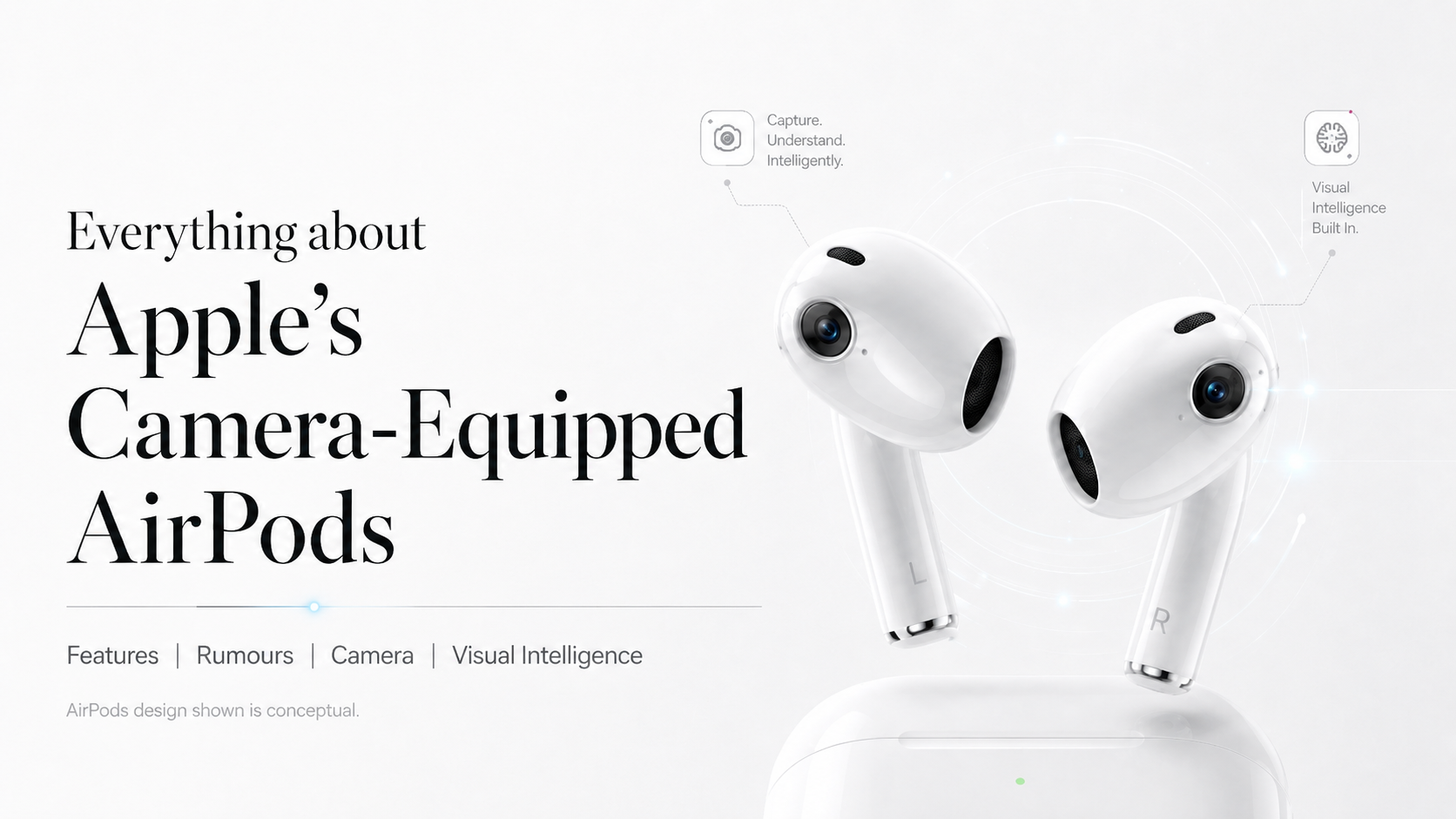
Apple may be preparing to take its artificial intelligence strategy in a surprising new direction: AirPods with built-in cameras.
A recently leaked Apple video, discovered inside the macOS Tahoe 26.7 release candidate, appears to show a future generation of AirPods using cameras and Apple’s Visual Intelligence technology. The discovery adds weight to earlier reports that Apple has been developing camera-equipped AirPods as part of its broader push into AI-powered wearable devices.
The concept is significant because these cameras apparently would not be intended to turn AirPods into miniature cameras for taking conventional photos or videos. Instead, they could allow Siri and Apple Intelligence to understand more of what the wearer is looking at.
That could turn an ordinary pair of wireless earbuds into an always-available visual assistant.
What the leaked video appears to show
The leaked demonstration is particularly interesting because it doesn’t merely show references to an unreleased product. It reportedly contains an actual short video showing a person wearing what appear to be future AirPods while interacting with an object in front of them.
In the demonstration, the user looks at a book. Siri explains that, with Visual Intelligence, the world can become “savable.” The user can ask Siri to save what they are looking at for later.
The example suggests a simple but potentially useful workflow: instead of taking out an iPhone, opening the camera and manually recording information, the wearer could simply look at something and ask Siri to remember it.
The video was discovered within a pre-release version of macOS Tahoe 26.7, which makes the discovery particularly notable. It appears to be an onboarding or explanatory video intended to demonstrate how the future AirPods could work.
Cameras designed for AI, not photography
One of the most important distinctions is how Apple reportedly intends to use the cameras.
According to earlier reporting, the cameras in these AirPods are not primarily designed for taking photographs or recording conventional video. Instead, they would provide visual information about the wearer’s surroundings to Siri. Potential applications include identifying objects, understanding surroundings, providing contextual information and improving navigation.
That makes the idea quite different from simply putting a camera into an existing pair of earbuds.
Think of it as giving Siri a pair of eyes.
For example, imagine walking through a city and asking:
- “What building am I looking at?” Or looking at a product and asking:
- “What is this?” Or seeing a poster and asking:
- “Remind me about this event.”
The cameras could provide the visual information while Siri handles the interaction.
These particular examples are possibilities rather than confirmed features, but they illustrate where Apple’s Visual Intelligence technology could become useful.
Visual Intelligence is already part of Apple’s AI strategy
The idea isn’t appearing from nowhere.
Apple has already introduced Visual Intelligence as part of Apple Intelligence. The technology can analyze visual information and help users understand objects, text and other content around them.
Apple’s developer documentation describes Visual Intelligence as a way for apps to integrate visual understanding, including processing images and identifying entities.
Apple has also previously described Visual Intelligence on supported iPhones as a way to get information about things the camera sees. The technology can therefore be viewed as a foundation for the more ambitious wearable experience Apple appears to be exploring.
Putting similar capabilities into AirPods could remove one major limitation: the user would not necessarily need to take out their phone.
What could camera-equipped AirPods actually do?
Apple has not published a complete feature list for these unreleased AirPods, so the following should be considered potential applications rather than confirmed features.
1. Identify objects
The AirPods could potentially recognize objects in front of the user and provide information through Siri.
You might look at a device, product, plant or other object and ask Siri what it is.
2. Recognize books and other media
The leaked demonstration specifically focuses on a book.
A future implementation could potentially allow Siri to recognize a book and save information about it for later.
3. Understand signs and posters
Visual AI could potentially interpret text appearing in the environment.
For example, a poster containing an event date could become something Siri can help you remember.
4. Provide contextual navigation
Earlier reporting has suggested that Apple’s camera-equipped AirPods could eventually provide contextual assistance while walking, including improved directions based on what the wearer is seeing.
5. Provide hands-free assistance
Perhaps the biggest advantage is convenience.
The user wouldn’t necessarily need to pull an iPhone from their pocket every time they wanted information about something in front of them.
That could make Visual Intelligence feel less like an iPhone feature and more like an ambient assistant that is simply available throughout the day.
What will the AirPods look like?
Based on current reporting and the leaked material, the future AirPods are expected to retain a design similar to Apple’s existing AirPods Pro line, although the stems may need to accommodate the additional hardware.
Earlier reports have suggested that the cameras could be integrated into the stems. MacRumors has also reported that an indicator light could be used to inform people nearby when the cameras are providing visual information to Siri.
The leaked demonstration does not provide enough information to answer every design question, however.
We still don’t know the final hardware configuration, camera specifications, battery impact or whether the design shown in the video represents the final retail product.
Privacy could be Apple’s biggest challenge
The technology may be impressive, but cameras on something as small and discreet as AirPods immediately raise privacy concerns.
This is one of the biggest differences between camera-equipped AirPods and a traditional smartphone camera.
When someone holds up an iPhone, it is obvious that they may be taking a picture. A tiny camera built into an earbud could be much less obvious.
That means Apple would need to make it extremely clear when the cameras are active.
Reports have suggested the company is considering visual indicators to alert people nearby when camera data is being used.
Apple’s existing approach to AI privacy may also become an important part of the product’s appeal.
How Apple’s Private Cloud Compute could matter
Apple says Apple Intelligence is designed to perform as much processing as possible directly on the device.
When a request requires more processing power, Apple Intelligence can use Private Cloud Compute, Apple’s cloud-based infrastructure for more demanding AI workloads.
Apple says data sent to Private Cloud Compute is used to fulfill the request and is not stored or made accessible to Apple. Apple also says independent researchers can inspect the software running on its servers to verify its privacy claims.
That doesn’t automatically answer every privacy question surrounding camera-equipped AirPods. The exact architecture Apple would use for visual information from the earbuds has not been publicly detailed.
Nevertheless, privacy-preserving AI processing could become a major selling point if Apple wants consumers to feel comfortable wearing camera-equipped devices in public.
Could AirPods become Apple’s first major AI wearable?
This may ultimately be the most interesting part of the story.
Apple has spent years turning AirPods from simple wireless headphones into a broader computing platform. They already provide features involving Siri, audio processing, health-related capabilities and interaction with Apple’s wider ecosystem.
Adding cameras and visual intelligence could take that strategy another step.
Instead of simply hearing the user, future AirPods could potentially understand what the user is seeing.
That would make them a very different kind of wearable.
And it could also be an important stepping stone toward Apple’s rumored smart glasses.
When could the camera AirPods launch?
This is where it is important to separate evidence from speculation.
The leaked macOS Tahoe 26.7 material provides evidence that Apple has been actively developing the technology. However, the existence of a demonstration video does not by itself establish a retail launch date.
Earlier reporting from Bloomberg, summarized by MacRumors, has pointed to late 2027 for camera-equipped AirPods, potentially alongside Apple’s 20th-anniversary iPhone. The timing could still change because Apple has not officially announced the product.
So, despite speculation about an earlier launch, there is currently no official Apple announcement confirming a release date.
What we still don’t know
There are still plenty of unanswered questions:
- Will the cameras be included in every model or only a premium AirPods version?
- Will both earbuds contain cameras?
- How much will the cameras affect battery life?
- Will the cameras be capable of conventional photography or strictly visual AI?
- What privacy indicators will Apple use?
- How much processing will happen on the AirPods, iPhone and Apple’s servers?
- Will the feature require a particular iPhone or Apple Intelligence-compatible device?
- How much will these AirPods cost?
- Will the final design resemble the product shown in the leaked video?
Apple has not officially answered these questions.
A potentially important change for AirPods
Camera-equipped AirPods sound unusual at first, but the idea becomes more understandable when viewed through Apple’s AI strategy.
Apple isn’t necessarily trying to create another camera.
It appears to be exploring a way to give Siri visual awareness without requiring users to constantly hold up a smartphone.
The leaked demonstration provides an intriguing glimpse of that concept: look at something, ask Siri about it, and let Apple Intelligence handle the rest.
Whether consumers will actually want cameras attached to their ears is another question.
The technology could be extremely convenient, but Apple will have to convince people that the benefits outweigh the privacy concerns.
For now, the safest conclusion is that Apple is actively exploring camera-equipped AirPods with visual AI capabilities, but the final product, features and launch timing remain unconfirmed.
Sources and further reading
- Apple — Apple Intelligence & Privacy
- Apple Security Research — Private Cloud Compute
- Apple Developer — Apple Intelligence and Visual Intelligence
- MacRumors — Apple’s Camera-Equipped AirPods Coming in Late 2027
- The Verge — Apple’s camera-equipped AirPods appear in leaked video
Editorial note: The camera-equipped AirPods discussed above have not been officially announced by Apple. Details based on leaked software, reporting and analyst/journalist sources should therefore be treated as unconfirmed until Apple makes an official announcement.