Quick Answer
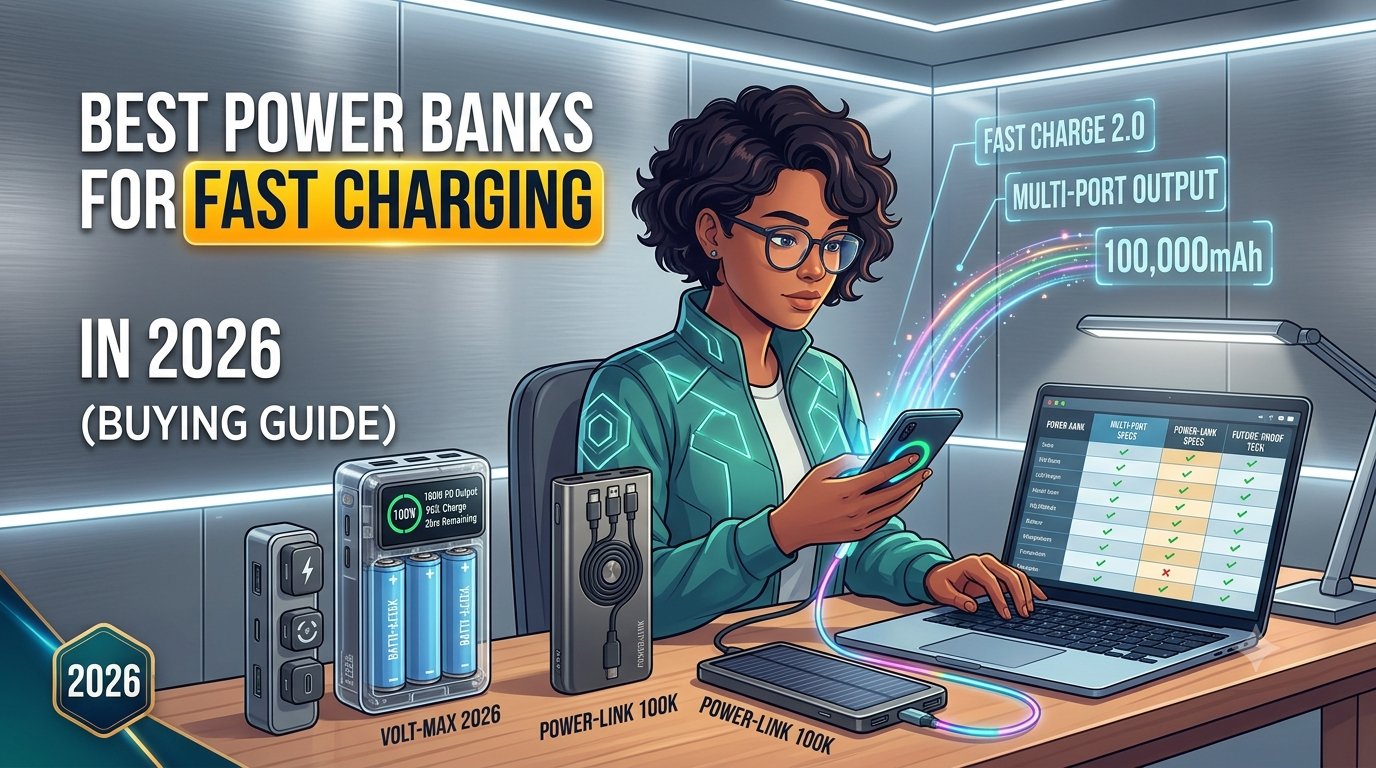
A power bank only charges as fast as its weakest link, so the number on the box doesn’t tell the full story. Look for 20W or higher output with USB-PD support, since that’s the protocol most modern phones actually use. Capacity matters less than people think — a 10,000mAh bank with proper fast charging will often feel quicker in daily use than a 20,000mAh one stuck on an old charging standard. Stick to known brands too; the safety certifications aren’t just paperwork, they’re the difference between a battery that ages well and one that swells up in a drawer six months later.
Why most “fast charging” power banks aren’t actually fast
Here’s the part nobody tells you when you’re scrolling through listings: a power bank can say “22.5W fast charging” on the box and still charge your phone slowly, because that number only applies if every part of the chain supports it — the bank’s output, the cable you’re using, and your phone’s input. Swap in a cheap cable you had lying around, and you’ve quietly capped your charging speed without realizing it. This is the single biggest reason people feel let down after buying a power bank that looked great in reviews.
The other catch is charging protocols. USB-PD (Power Delivery) is the closest thing to a universal standard right now and works across most current Android phones and iPhones. Quick Charge, on the other hand, is largely a Qualcomm/Android thing and won’t necessarily speed up an iPhone at all. If you’re buying for a household with a mix of devices, PD support is the safer bet.
Capacity is a tradeoff, not a goal
It’s tempting to just buy the biggest mAh number you can find, but that’s usually the wrong instinct. A 20,000mAh bank weighs noticeably more — you’ll feel it in a bag after a day of carrying it around — and it also takes longer to recharge itself overnight. For most people, 10,000mAh covers a day of moderate phone use with one and a half to two full charges, and it’s small enough to actually carry every day instead of leaving it at home. Save the bigger capacities for actual travel days, flights, or camping trips where you won’t see a wall outlet for a while.
One more thing worth checking: pass-through charging. This lets you plug the power bank into the wall and charge a phone off it at the same time, which is genuinely useful if you tend to top everything up overnight rather than babysitting a charging queue.
What I’d actually buy at each budget
If you want something reliable for everyday carry: [Insert your top all-rounder pick — 10,000-20,000mAh with PD support]. This is the one to grab if you just want something that works without thinking about it.
If you’re not trying to spend much: [Insert budget pick — look for at least 18W output even at lower price points]. It won’t have the extras, but it’ll get the core job — actual fast charging — right.
If you’re traveling or going somewhere without outlets for a while: [Insert higher-capacity, multi-port option]. The extra weight is worth it when you’re charging a phone, earbuds case, and maybe a smartwatch all from the same bank.
If you’re specifically on iPhone: [Insert MFi-certified or confirmed PD-compatible pick]. Apple’s charging behavior is a little particular, so it’s worth checking compatibility specifically rather than assuming any PD bank will work the same way.
A few questions people usually ask after buying one
Does a power bank wear down your phone’s battery faster? Not if it’s a decent one — proper protection circuitry keeps the voltage steady. The actual risk comes from unbranded banks that cut corners on that circuitry, since inconsistent voltage over time is what actually stresses a battery.
Is it worth paying extra for higher capacity? Only if you genuinely need it. Match it to how you actually use your phone day to day rather than buying for a worst-case scenario that rarely happens.
Can you bring one on a flight? Yes, but it has to go in carry-on, and most airlines cap it around 100Wh (roughly 20,000-27,000mAh) without needing special approval — worth a quick check with your specific airline before you fly.
What I’d actually buy at each budget
- If you want something reliable for everyday carry, the Mi Power Bank 4i is the easy recommendation. It’s got 33W two-way fast charging and three output ports (2x USB-A + 1x USB-C), so you’re not stuck waiting around or fighting over which device gets to charge first. This is the one to grab if you just want something that works without overthinking it.
- If you’re not trying to spend much, the Spigen ArcPack 10000mAh is worth a look. It comes in under ₹1,000 and still manages 22.5W with PD 3.0 support, which is rare at that price point — most budget banks cut corners exactly here. It won’t come with extra frills, but it gets the core job right.
- If you’re specifically on iPhone, the Anker PowerCore Slim 10000 PD is the one I’d point you toward. Its 20W USB-C PD output plays well with how Apple’s charging behaves, and Anker’s warranty and service network in India add a layer of peace of mind that cheaper brands don’t really offer.
- If you’re traveling or heading somewhere without outlets for a stretch, go bigger with the Mi 20000mAh Pro. It supports 45W PD, which is enough to top up a laptop in a pinch, not just a phone — useful if you’re the type who’s charging a phone, earbuds case, and laptop all from the same bag. If you want something similarly high-capacity but a bit cheaper, the Ambrane Stylo 20K is a solid alternative, though it’ll take longer to recharge itself overnight.
- And if you regularly need to charge a MacBook or similar laptop on the go, it’s worth stepping up to the Anker 737. At 140W output, it’s really in a different category from the rest of this list — built for people who can’t afford to run out of power mid-shoot or mid-flight, rather than for casual phone top-ups.
A few questions people usually ask after buying one
Does a power bank wear down your phone’s battery faster?
Not if it’s a decent one — proper protection circuitry keeps the voltage steady. Brands like Mi, Anker, and Spigen all build in multiple layers of circuit protection specifically for this reason. The actual risk comes from unbranded banks that cut corners here, since inconsistent voltage over time is what actually stresses a battery.
Is it worth paying extra for higher capacity?
Only if you genuinely need it. The Mi Power Bank 4i’s 10,000mAh is plenty for daily use, while something like the Mi 20000mAh Pro or Ambrane Stylo 20K makes more sense if you’re traveling or charging multiple devices off one bank. Match it to how you actually use your phone day to day, not a worst-case scenario.
Will any of these actually fast-charge my iPhone?
Not all of them equally. The Anker PowerCore Slim 10000 PD is specifically built around USB-C PD, which is what Apple’s fast charging relies on — so that’s the safer bet for iPhone users over a bank optimized mainly for Quick Charge (which is more of an Android/Qualcomm standard).
Can I bring one of these on a flight?
Yes, but it has to go in carry-on, not checked baggage. Most airlines cap it around 100Wh, which works out to roughly 20,000-27,000mAh depending on voltage — so even the higher-capacity options like the Mi 20000mAh Pro stay within that limit. The Anker 737, being a higher-output laptop charger, is still fine on capacity but worth double-checking against your specific airline’s policy since it’s a more premium device.
How long do these actually last before the battery degrades?
Most decent power banks are rated for 300-500 full charge cycles before capacity noticeably drops, which usually works out to about 2-3 years of regular use. Mi specifically rates some of its lineup to retain around 80% capacity even after 300 cycles, which is a reasonable benchmark to compare other brands against.